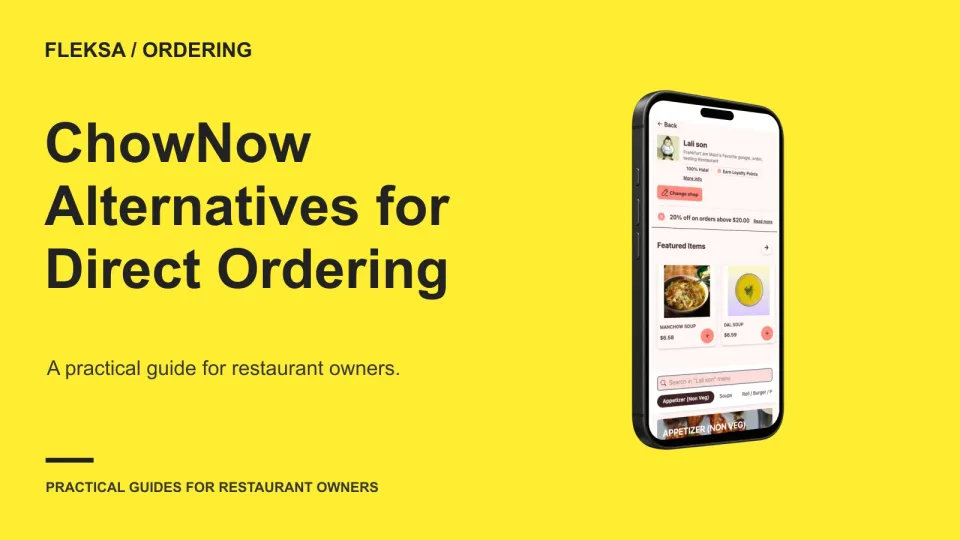
Fleksa is one ChowNow alternative to consider if you want direct online ordering alongside a restaurant website and other restaurant tools. Owner.com, BentoBox and Sauce are also names to investigate, but ask each provider to demonstrate the ordering workflow and provide a written quote before comparing them.
The right choice depends on more than the advertised commission. Check who controls customer information, how delivery gets dispatched, whether orders reach your POS and what happens when you leave. Keep ChowNow in the comparison if its current setup still meets some of your needs.
Set your direct ordering requirements
Start with the order you want a guest to place. Should they find your restaurant on a search page, visit your own website, choose pickup or delivery, and pay without calling? Write down each step and identify where the order should appear for your staff.
Then separate essential requirements from nice-to-haves. A small pickup operation may care most about menu changes and a clear kitchen ticket. A delivery-heavy restaurant may need reliable dispatch coverage and a way to handle late drivers. A restaurant already committed to its POS may put that connection ahead of a new website.
Customer relationships and discovery
Direct ordering gives you a channel to serve customers who already know your restaurant. It does not automatically bring the same discovery as a marketplace. Decide whether you need both channels, then compare their contribution after the costs of fulfilling an order. This guide to direct and marketplace order contribution can help with that calculation.
Ask what customer information your team can see and export, which fields are included, and whether order history comes with it. Access to a list is different from permission to send marketing messages. Ask how consent is recorded and what happens to that information if you change providers. Consult a qualified adviser about the terms that apply to your business.
For discovery, ask where guests land after clicking an ordering link and whether your own domain remains visible. If Google ordering or bookings matter to you, ask what is available for your location and have the provider show the guest path. A provider can support a channel without guaranteeing how prominently your restaurant appears in search.
Delivery and the POS
Decide who supplies drivers, who pays for each dispatch and who handles a delivery problem. Ask about the delivery area, busy-period charges, canceled orders and support when a driver cannot be assigned. Fleksa is not a courier fleet, so discuss the delivery arrangement separately.
For a POS connection, give each vendor your exact POS product, version and location setup. Ask which details pass between systems: items, modifiers, taxes, tips, payment status and cancellations. Also ask what staff must enter by hand. A connection is only useful if it handles the orders your restaurant actually sells.
Build a shortlist around the work you need done
Use the table to decide which conversations to start, not as a feature comparison. The questions are deliberately specific: the answer should be a demonstration or a written term for your location.
| Provider | Consider when | Ask in the demo or quote |
|---|---|---|
| ChowNow | You want a baseline against your existing ordering arrangement. | What would your current and renewal costs be, and what data can you take with you? |
| Fleksa | You want to explore a website and direct ordering with other restaurant software. | How would your POS and delivery arrangement work, and what is included in your quote? |
| Owner.com | Website and repeat-customer marketing are important to your decision. | Which ordering and marketing functions are included, and what are the full charges? |
| BentoBox | You want to evaluate website presentation alongside ordering. | Show the complete ordering path and quote setup, ongoing service and processing. |
| Sauce | Delivery operations are a major part of your decision. | Who dispatches drivers in your area, what does each delivery cost, and how are exceptions handled? |
For Fleksa, the relevant tools include a restaurant website, direct online ordering and marketing tools; reservations and POS are also part of its broader software offering. Confirm availability and setup for your restaurant, especially any connection to equipment or services you already use.
Take two or three candidates into a deeper review. If a provider cannot show the workflow you need or explain the cost of it, treat that as an unresolved item rather than assuming the feature is included. Ask your current provider the same questions: staying may be sensible if its revised terms and workflow meet your requirements.
Compare complete costs and exit terms
Give every provider the same order mix and ask for an itemized quote. Include the monthly platform charge, order-based commission, payment processing, dispatch, setup, hardware or add-ons, and any applicable tax. List charges paid by the restaurant separately from charges paid by the guest.
A processing quote alone is not the all-in cost of operating the channel. Likewise, zero provider commission on an eligible order does not make processing or delivery free. Ask whether fees apply to pickup and delivery alike, what amount a percentage fee is calculated on, and whether minimums or volume thresholds apply.
A hypothetical delivery calculation
Assume one location receives 300 direct delivery orders in a month. For illustration only, assume dispatch costs $6 per order and the restaurant pays the entire dispatch charge. There are no assumed guest delivery charges in this calculation.
Fleksa Fix is listed at $199 per month per location, with 0% Fleksa commission on direct online orders. The Fleksa plans page was checked in November 2026. At the assumed dispatch price, 300 deliveries cost $1,800; adding the $199 fixed subscription gives $1,999 for the month. The subscription portion is about $0.66 per order.
That subtotal includes the fixed subscription and the assumed variable dispatch expense. It excludes processing, setup, hardware or add-ons, applicable tax and exception costs such as cancellations or redelivery. The dispatch figure is an assumption, not a quote. Actual delivery charges may vary, so get written terms before using the subtotal in a decision.
If guests pay a delivery charge, show it separately: it may offset part of the restaurant's dispatch expense, but it remains a cost to the customer. Do not count food sales or payment deposits as fee reductions. To compare another provider, use the same 300 orders and the same delivery assumptions where applicable, then add that provider's quoted fixed, variable and exception charges. Without those amounts, there is no fair total-cost winner.
Ask what it costs to leave
Check the initial term, renewal date, notice period and any early termination or export charges. Ask who controls the domain, website content, menu, customer records and ordering links. Get the export format and timing in writing, including what happens to historic orders after cancellation.
Compare the quote over the period you expect to use the service, not just the first month. A low introductory charge can be less useful if setup, renewal or exit costs are high. Have a qualified adviser review contract or tax questions when needed.
Use the same demo checklist for each finalist
Send vendors a short version of your real menu before the demo, including an item with modifiers, an unavailable item and your pickup and delivery rules. Ask them to walk through these checks in a test environment. A practice order must not create a real card payment, guest message or courier dispatch.
- Place a simulated order. Show the guest path from your website or ordering link through item selection, modifiers and a simulated checkout. Confirm what information the guest sees before placing it.
- Follow the order into operations. Show where staff accept it, how the kitchen sees the details and what appears in your specific POS, if connected. Ask what happens if the connection fails.
- Change and cancel it. Walk through an unavailable item, an order correction and a cancellation. Identify who acts, how payment status would be handled and any associated charges.
- Walk through delivery without dispatch. Show how a driver would be requested, how coverage and charges are determined, and who staff would contact if no driver accepted. Keep the demonstration simulated.
- Inspect customer data. Show the fields available to staff, how consent is recorded and how an export would work. Ask whether order history and marketing preferences are included.
- Price the exact setup. Match the demonstrated functions to a written quote. Mark every item as included, extra or requiring a separate provider.
After the demo, score each finalist against your essential requirements. For example, if your biggest problem is manually entering delivery orders into the POS, a lower subscription should not outweigh an unproven POS workflow. If pickup is your priority and you do not need dispatch, avoid choosing a more complicated delivery setup merely because it is available.
A simulated check is not a live service pilot. If you proceed to a live pilot, agree on its scope, staff responsibilities and support contacts first. Decide how real orders will be monitored and how staff will handle a problem. Switching systems carries operational risk, so keep a fallback process and do not assume service will be uninterrupted or that every order will transfer.
Choose your next step
Put your must-haves, order volume and current costs on one page. Request matching written quotes, run the same demonstration with each finalist and resolve the customer-data and exit questions before signing.
To see whether Fleksa fits your workflow, review its restaurant ordering system and request a demonstration using your own menu, POS and delivery requirements.
Frequently asked questions
What should I compare besides the monthly fee?
Compare processing, dispatch, setup, add-ons and exception charges, as well as customer-data access, POS workflow, support and exit terms. Use the same order assumptions for every quote.
Does commission-free ordering mean free delivery?
No. A qualifying direct ordering plan may charge no provider commission while delivery or dispatch and payment processing still cost extra. Confirm who pays each charge.
Can I keep a marketplace while adding direct ordering?
You can evaluate the channels separately and decide what mix suits your restaurant. Compare their contribution and operating workload rather than assuming they bring the same customers or have equivalent costs.