
Updated August 2026.
Restaurant website speed matters because restaurant visits are unusually time-sensitive. A guest is not researching enterprise software for next quarter. They are deciding where to eat, checking whether a dish is available, booking a table, or trying to place an order before the kitchen closes.
Speed supports that journey, but the honest 2026 story is broader than faster pages rank higher. Mobile usability, stable layouts, crawlable menus, clear business information, and a short path to ordering work together. This guide explains what speed changes for guests, SEO, AI-assisted discovery, and restaurant operations—and what it does not guarantee.
The short answer
A fast restaurant website helps people reach the menu and act with less friction. Google uses Core Web Vitals within its ranking systems, but explicitly says that good scores alone do not guarantee top rankings. For AI Overviews and AI Mode, Google recommends the same fundamentals as traditional SEO: crawlable pages, useful text, internal links, accurate structured data, quality media, and a good page experience.
In other words, speed is infrastructure for discovery and conversion. It is not a substitute for a relevant menu, accurate hours, strong local reputation, or food people want.
Why restaurants feel slow websites more sharply
Restaurant traffic concentrates around moments of intent. During lunch and dinner, many guests arrive from a map result or branded search with three questions:
- What is on the menu?
- Are you open and can I order or reserve now?
- How quickly can I complete the next step?
A slow article may lose a reader. A slow restaurant menu can lose an order that was ready to happen. That is why the most useful performance measure is not an abstract score; it is whether the largest useful content appears quickly, the page remains stable, and taps respond without delay.
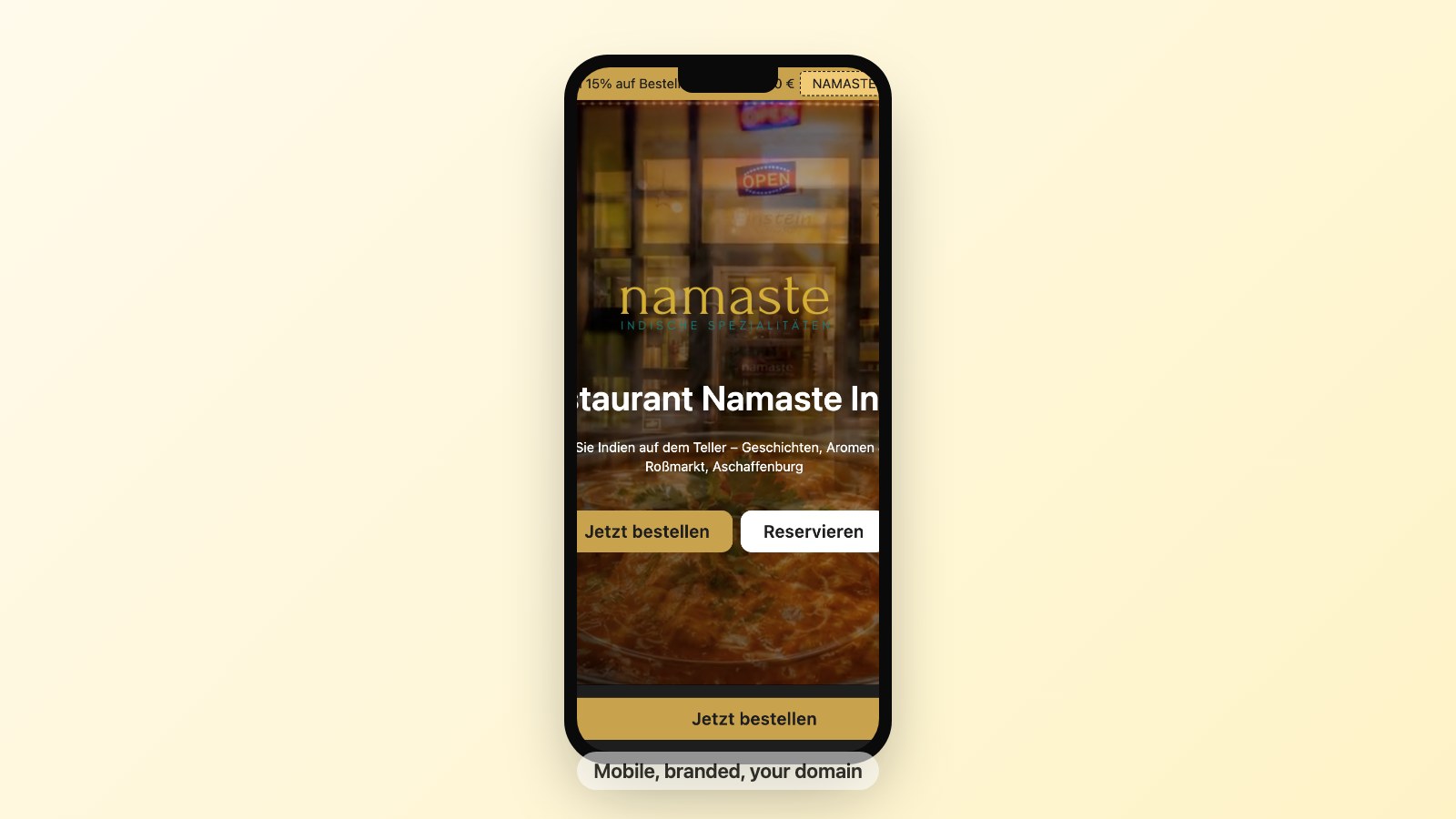
The three Core Web Vitals restaurant owners should know
Google's Core Web Vitals documentation defines three current user-centered metrics. The recommended thresholds are evaluated at the 75th percentile of page loads.
| Metric | Good threshold | Restaurant example |
|---|---|---|
| Largest Contentful Paint (LCP) | 2.5 seconds or less | The hero, restaurant name, or menu heading becomes visible |
| Interaction to Next Paint (INP) | 200 milliseconds or less | The menu, order button, or navigation responds to a tap |
| Cumulative Layout Shift (CLS) | 0.1 or less | Logos, banners, and menu sections do not jump after appearing |
Lighthouse is a lab diagnostic. Search Console's Core Web Vitals report uses aggregated real-user data when enough data exists. Use both: Lighthouse helps reproduce and fix a problem, while field data shows what eligible users experienced over time.
Speed and restaurant SEO: what Google actually says
Google's core ranking systems use signals aligned with page experience, including Core Web Vitals. Google also cautions against chasing a perfect score purely for SEO: relevance remains more important, and page experience includes more than a few metrics. The primary source is Understanding page experience in Google Search.
For a restaurant, the practical SEO value of performance is that it supports everything else the page needs to accomplish:
- Search crawlers can reach stable, server-readable menu and location content.
- Guests can use the page comfortably on mobile devices.
- Internal links can connect cuisine, location, menu, reservation, and ordering pages.
- Structured restaurant and menu information can match what visitors actually see.
- The branded domain can retain the complete search and conversion journey instead of redirecting to a third-party ordering site.
Performance does not make thin or duplicate pages useful. A fast page with copied text, incorrect opening hours, or an inaccessible menu is still a poor search result.
Does website speed matter for AEO and AI search?
Yes, but not because an AEO plugin awards a special score. Google's 2026 guidance says its generative search features are grounded in the same search ranking and quality systems. Pages must be indexed and eligible for a Search snippet to appear as supporting links. There is no special AI schema or required AI text file.
Google recommends:
- Allowing crawl access through robots and hosting infrastructure.
- Making important content available as text.
- Using clear internal links.
- Providing a good experience across devices with reduced latency.
- Keeping structured data consistent with visible content.
- Maintaining accurate Business Profile information.
Read the primary guidance in AI features and your website and Google's generative AI optimization guide.
The useful AEO lesson is simple: publish clear, original answers on pages that humans and crawlers can reliably access. Speed helps those pages work. It does not replace expertise, attribution, or unique information.
Why a complete HTML menu matters
A restaurant's menu is not decorative content. It contains the dishes, prices, dietary information, cuisine signals, and ordering choices that answer high-intent questions.
A PDF menu can be awkward on a phone. An iframe can separate the menu from the restaurant's page structure and analytics. A menu that only appears after heavy client-side work creates more opportunities for users and crawlers to receive an incomplete experience.
The better pattern is a real menu page on the restaurant's own domain:
- Useful menu content is present in server-delivered HTML.
- Categories and dishes remain readable without a manual Load more step.
- Interactive ordering loads without replacing the page with a visibly different product.
- Prices and availability come from the same operational source used by the restaurant.
See how this fits into a complete setup in Restaurant Website + Online Ordering on One Domain.
Speed also changes infrastructure economics
At platform scale, unnecessary work compounds. If every page request validates a large sitemap, repeats an API call, or asks the database for content that was already fetched, bot traffic and normal traffic pay the same tax. The site feels slower and the restaurant platform needs more capacity to deliver the same customer value.
Good caching, controlled crawler access, server-rendered public content, and removal of duplicate work improve two outcomes at once: guests wait less, and infrastructure performs less wasteful work.
This does not mean blocking search engines. Important restaurant pages must remain crawlable. The goal is to serve valuable pages efficiently while rate-limiting abusive behavior and avoiding infinite or duplicate URL spaces.
What a restaurant owner should demand in 2026
- A mobile homepage and menu that pass Core Web Vitals with real-user data when available.
- A complete menu on the restaurant's own domain.
- No layout jumps when logos, offers, or ordering controls appear.
- Ordering and reservations reachable without a third-party visual handoff.
- Accurate titles, descriptions, canonical URLs, language alternates, and restaurant structured data.
- Search Console access so performance and visibility are measurable.
- Repeated testing after releases—not a screenshot taken once during the sales process.
The bottom line
Restaurant website speed matters because it protects a high-intent mobile journey. It supports ordering, reservations, crawlability, SEO, and AI discovery. But the winning product is not the fastest empty page. It is the fastest complete experience.
For the engineering evidence behind this conclusion, read Fleksa's restaurant website performance case study. To test your own site, follow the 2026 restaurant website speed checklist.
Explore Fleksa restaurant websites with ordering built in, or talk to the team.

